
How HiPP cut data platform cost by ~90% with a unified data layer
Germany
Food & Beverage (organic baby food & care)
3,000+ employees
>1B EUR revenue
130M+ jars and pouches per year
How a leading organic food manufacturer connected every plant to a single data layer, cutting platform cost and effort by roughly 90%.
.avif)
"With UMH, we gained real-time insight into our production for the first time. The platform’s flexibility allowed us to connect all our machines and drastically reduce manual data work. This has been a game-changer for our efficiency."
Months to days
Use-case development lead time
~90%
Reduction in data platform cost and effort
130M+
Jars and pouches produced annually
SAP DM
MES integration unblocked
The challenge
Fragmented infrastructure, stalled MES transition
Every use case a separate project. No reliable integration path to SAP DM.
Fragmented technology footprint drives high project cost and time to value
Decades of organic growth left HiPP with a tangle of point-to-point connections across its plants. An earlier IoT platform initiative still could not aggregate all relevant production data. Every new use case required its own integration project. Mandatory long-term monitoring of large refrigeration units, for example, was quoted in the "tens of thousands of euros per site and months of effort" range, making each new IIoT use case prohibitively expensive.
Critical connectivity gap to next-generation MES
HiPP is transitioning to SAP Digital Manufacturing, but SAP PCo will be end-of-life in 2027, leaving no reliable integration option between shop-floor assets and the new MES. Without a data layer capable of connecting existing equipment to SAP DM, the entire MES transition project was at risk.
No contextualized data foundation for future AI and analytics
Production data is a strategic priority for HiPP, but it remained scattered across systems and non-semantic in structure. This put forthcoming AI and machine learning initiatives at risk and limited the value of existing data science resources. Without a unified, contextualized data foundation, advanced analytics had no reliable input.
THE SOLUTION
Enterprise Data Layer Across Multiple Sites
One structured data feed to all systems. Platform cost cut by 90%.
Connected every key data source
UMH runs as an edge abstraction layer, ingesting live data from PLCs, sensors, Kepware, and energy meters via MQTT, OPC UA, and REST gateways, then streaming a single data feed to both on-prem and cloud targets, including SAP DM.
Modeled and contextualized the data based on ISA-95 and UNS
A unified namespace and reusable templates standardize tags, line identifiers, and batch metadata, giving engineers a single, searchable view across all plants. Cross-line analytics work immediately.
Enabled the team to build applications fast
Plant engineers now spin up Grafana dashboards, OEE widgets, and anomaly-detection alerts through UMH's interface, cutting typical use-case lead time from months to days.
Architecture
From shop floor to SAP Digital Manufacturing in one architecture
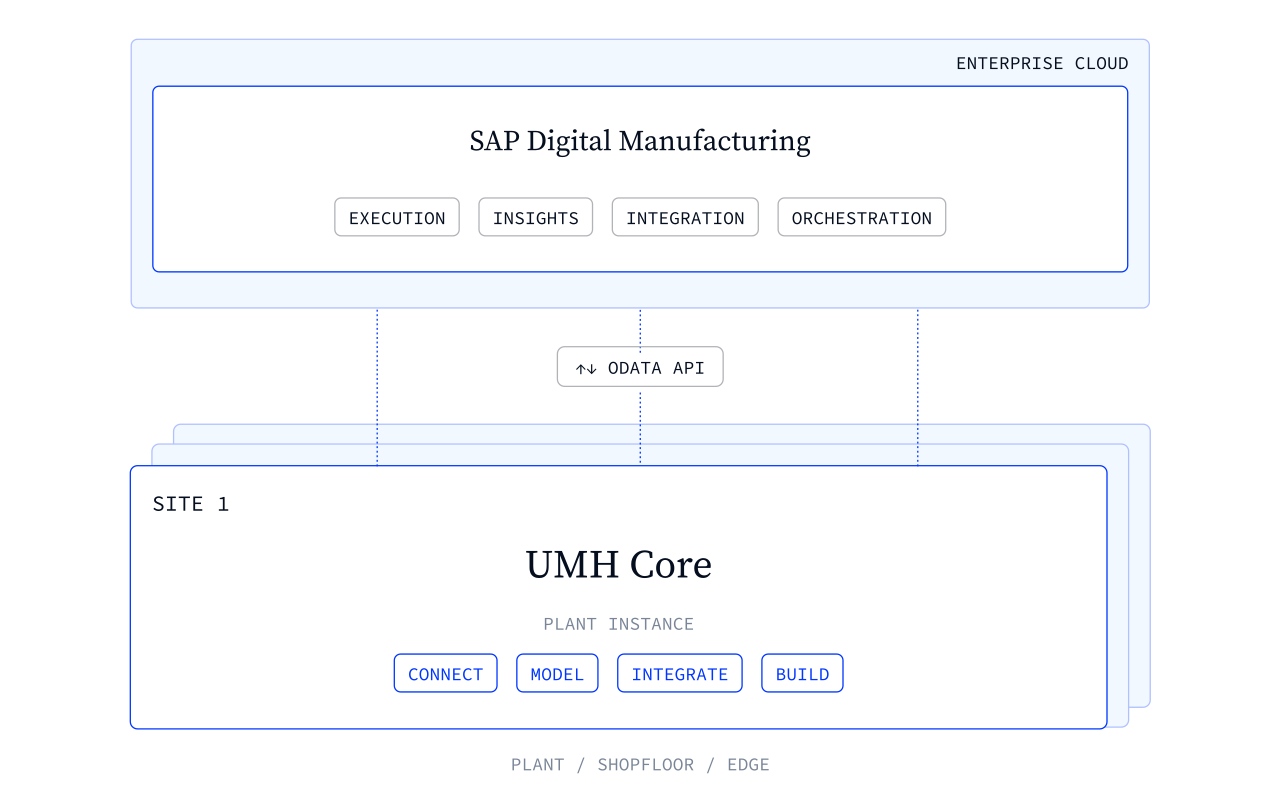
Machines / PLCs on the shop floor → United Manufacturing Hub edge layer → real-time streams to enterprise systems (ERP, MES, SAP DM, cloud analytics).
Edge connectivity flow
UMH converts every raw signal into a JSON "event" with standardized location and content fields, creating a scalable, vendor-agnostic data foundation.
Event-based data model
All events are automatically persisted in the UMH time-series historian for long-term retention, compliance, and back-testing.
Built-in historian
Contextualized data is exposed through a single namespace, powering dashboards, AI/ML analytics, and real-time integrations.
Unified namespace & context tags





~90%
Cost and effort reduction
Months > Days
Use-case lead time
Unblocked
SAP DM Integration
Download the excerpt!












solutions
Solutions Built on UMH.
UMH is the data infrastructure. These are the outcomes it delivers.