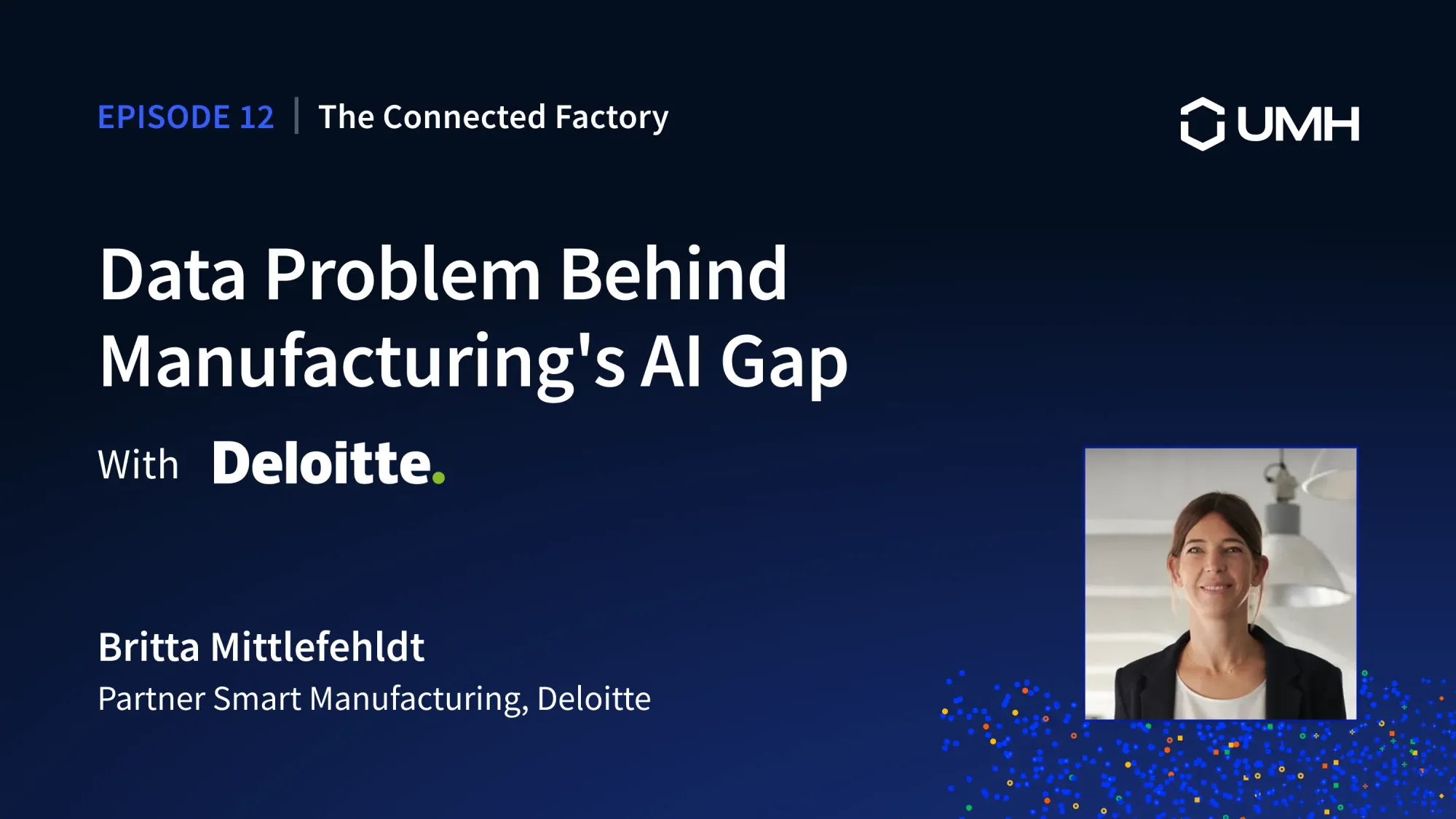
The Data Problem Behind Manufacturing’s AI GAP w/ Deloitte | EP12 - The Connected Factory Podcast
Nearly 70% of manufacturers say data quality is their biggest barrier to AI. Most teams treat this as an AI problem. It's not.
In this episode, Niklas Hebborn, CCO at UMH, talks with Britta Mittlefehldt, Partner Smart Manufacturing at Deloitte, about what it takes to digitalize manufacturing at scale. Britta brings an unusual background to this conversation: certified welding engineer, former plant manager in China, and 16 years in consulting at Deloitte. She gives a direct read on where the industry stands today, why lighthouse projects rarely move beyond the pilot stage, and what distinguishes companies acting now from those still deciding when to start. Topics include the IT/OT convergence challenge, data ownership, Unified Namespace, and Deloitte's Smart Factory in Düsseldorf - a working production facility built to let manufacturers test connected factory infrastructure before committing to a full rollout.
Highlights from this episode:
- Why manufacturers need to rethink processes from scratch rather than digitize existing ones
- How target operating models are reshaping IT/OT responsibilities inside large manufacturers
- Who owns manufacturing data, and why the answer varies by company
- How Unified Namespace gives operations teams a data structure they can work with
- Why time-to-value is the main factor in whether digital programs scale across plants
- The Deloitte Smart Factory in Düsseldorf: what it is, how it works, and how manufacturers can use it to test solutions
- Physical AI and robotics as the next area of investment for European manufacturers
Key Takeaways
This Wave of Change Is Structurally Different
Earlier cycles, lean manufacturing, Industry 4.0, early IoT — built on existing processes. The current shift requires starting over. The old logic of "optimize before you digitize" does not hold when the process itself needs to change. Manufacturers building AI into their operations now are not improving what existed before; they are designing something new.
Speed Is the Scaling Problem
Lighthouse projects demonstrate what is possible, but scaling across 20, 50, or 200 plants stalls repeatedly. The core issue is not technology availability. It is a tendency to over-engineer before rollout, combined with difficulty attributing productivity gains to a plant manager's P&L. Reducing time-to-value and solving the scaling problem are the same challenge.
IT/OT Convergence Is an Organizational Problem
Most large manufacturers have spent the past two to three years redefining who is responsible for what across IT and OT, often prompted by cybersecurity incidents. The emergence of dedicated roles such as Head of Smart Manufacturing and Head of Digital Manufacturing makes it easier to drive cross-plant programs. Without a clear owner, these programs stall at the plant level.
Data Ownership Is Unresolved
Whether operational data belongs to the business or IT remains open, and the right answer varies by company. A related question is gaining urgency: should manufacturers contribute their data to train shared industrial AI models, and what competitive advantage do they give up by doing so?
Unified Namespace Fits How Manufacturing Teams Think
Many data architecture concepts do not land with operations teams. Unified Namespace works because it maps to how manufacturers already categorize functions and systems. It gives teams a concrete way to structure and share data across machines, sites, and systems, which is a prerequisite for AI agents to function correctly.
AI Agents Require Structured Data
Agents produce useful output only when given accurate context. Without a structured, unified data layer, directing agents toward the right problem is not practical. Data infrastructure is not a future investment; it determines whether AI initiatives deliver anything at all.
Physical AI Addresses Europe's Specific Cost Pressures
Machines that adjust their own parameters based on sensor data and AI-driven analysis are already operating in production environments. For European manufacturers facing high labor and energy costs, this category of automation is a direct response to competitive pressure from the US, India, and South Korea.
The Deloitte Smart Factory Tests Infrastructure, Not Just Concepts
The Düsseldorf facility runs a real production line, assembling STEM toys and replicates the full infrastructure stack that clients need to build: machine connectivity, cybersecurity, data pipelines, and system integrations. Manufacturers can use it to test specific solutions before committing to a full program.